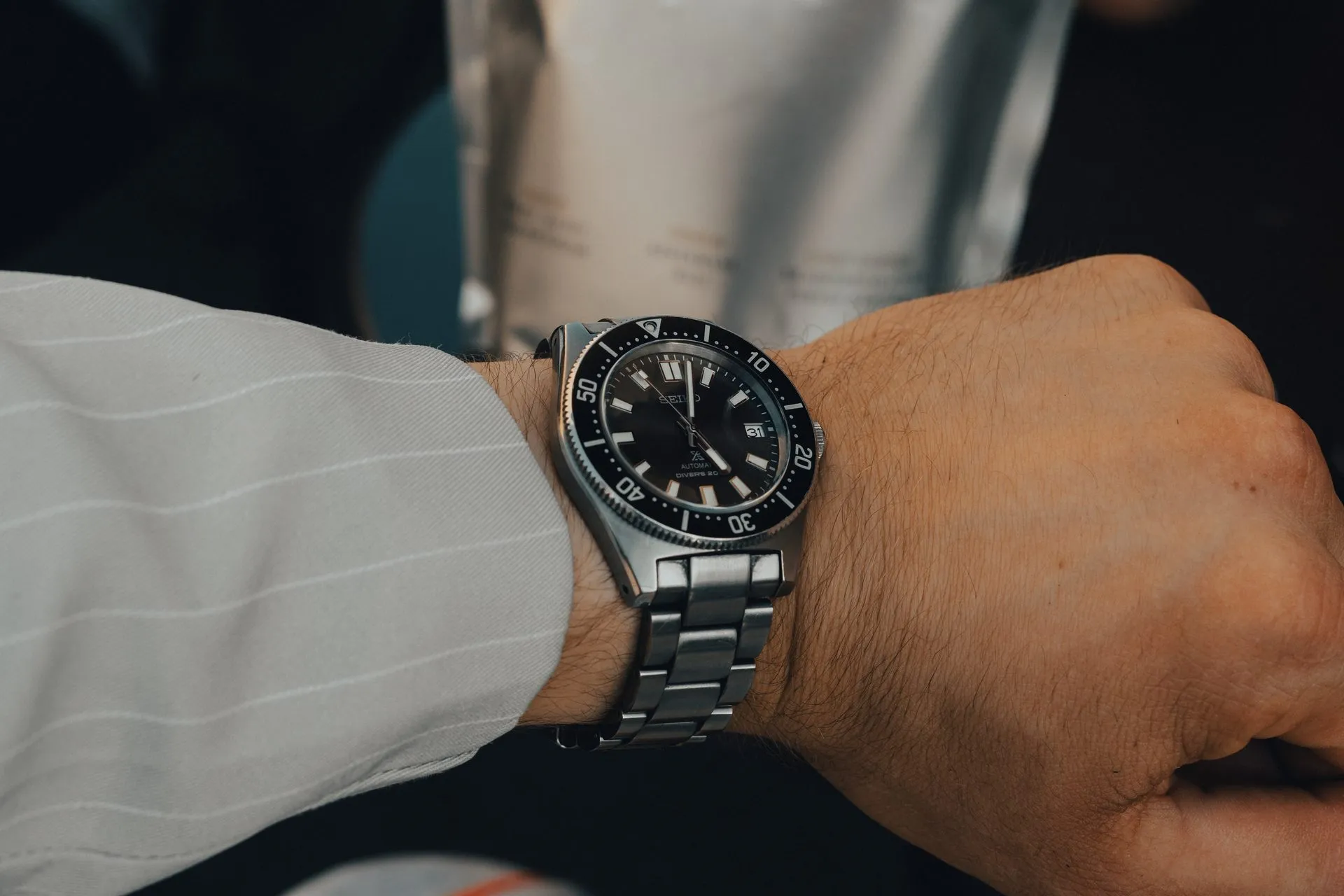
Diameter is the figure everyone looks at, but it is not the one that decides whether a watch suits you. What matters is the lug-to-lug: the distance from tip to tip of the lugs, where the strap attaches. If it is wider than your wrist, the lugs overhang at the sides and the watch looks big, whatever its case measures.
How to measure
- Take a sewing tape measure or a strip of paper.
- Wrap it around your wrist just above the bone on the little-finger side, without pulling tight.
- Note the circumference in centimetres.
The rule
Seen from above, your wrist is roughly a third as wide as its circumference. The watch’s lug-to-lug should stay below that width; with a 5% margin, the watch sits within the wrist.
| Circumference | Approx. width | Maximum lug-to-lug |
|---|---|---|
| 14 cm | 46 mm | 44 mm |
| 15 cm | 50 mm | 47 mm |
| 16 cm | 53 mm | 50 mm |
| 17 cm | 56 mm | 53 mm |
| 18 cm | 59 mm | 56 mm |
| 19 cm | 63 mm | 60 mm |
| 20 cm | 66 mm | 63 mm |
It is an approximation: a flat wrist takes a little more than a round one. But it is enough to rule watches out without trying them on.
An example
The Seiko Prospex Turtle measures 45 mm across, a figure that sounds large. But its cushion case keeps the lug-to-lug at about 47.7 mm, less than many 42 mm watches. That is why it wears well on 16 or 17 cm wrists. You can see every size in the lists of 39.5 mm or less, 40 mm and 42 mm or more.
Try it with a watch
Pick a model and move the slider to your circumference. You will see the width of your wrist and how much of it the lugs take up.